
What Does Skin Cancer Look Like?
“What Does Skin Cancer Look Like?” and Other Frequently Asked Questions About Skin Cancer
You notice a new spot on your skin, something that wasn’t there last month. Maybe it’s a small bump, a mole that looks different, or a patch that won’t heal. Most of the time, it’s harmless. But sometimes, that tiny change is a sign of something more serious: skin cancer.
Here at the Laser and Skin Surgery Center of Indiana (the LASSI), we know that moment can cause worry and uncertainty. You might wonder, “Is this normal?” or “Should I get this checked?” Our goal as board-certified dermatologists and dermatology providers is to help you recognize when to take action because when it comes to skin cancer, early detection can save your life.
Skin Cancer Is Common, Easy to Miss
Skin cancer is the most common cancer in the United States, and while most cases are treatable, they can become dangerous if ignored. The challenge? Skin cancer doesn’t always look the same. Some lesions look like harmless moles, scars, or even dry skin, while others may appear suddenly and grow rapidly.
That’s why awareness and early evaluation are critical. Knowing what to look for empowers you to act before cancer has a chance to spread.
Indianapolis’s Trusted Skin Cancer Specialists
Our board-certified dermatologists and dermatology professionals at the LASSI specialize in the diagnosis and treatment of all skin cancer types.
Our founder and medical director, C. William Hanke, MD, is an internationally recognized expert in Mohs micrographic surgery, the most precise and effective skin cancer treatment available. Under his leadership, we have treated skin cancer patients in Indianapolis with precision, compassion, and care.
Now, we’re here to guide you in recognizing the signs of skin cancer, when to take action, and how to protect your health.
What Does Skin Cancer Look Like? Let’s Take a Look
Skin cancer doesn’t have a single “look.” Each type appears differently depending on its depth, growth rate, and location. Let’s take a look at the three most common types of skin cancer are basal cell carcinoma, squamous cell carcinoma, and melanoma.
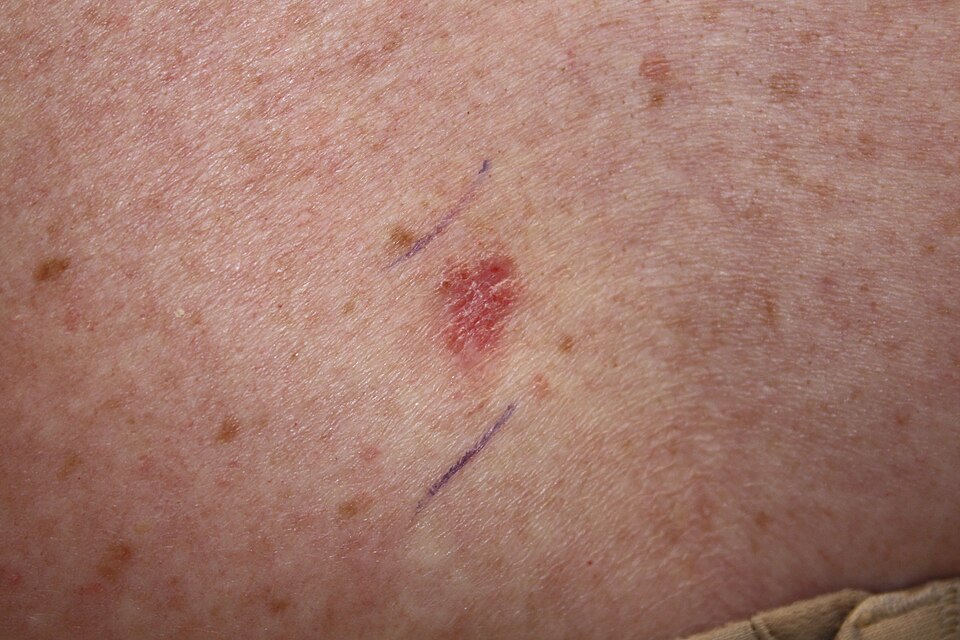
Basal Cell Carcinoma (BCC)
The most common type of skin cancer
May look like a pearly or waxy bump with visible blood vessels
Can also appear as a flat, pink patch or look like a scar
Sometimes crusts, bleeds, or forms a sore that doesn’t heal
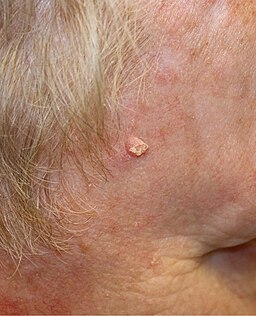
Squamous Cell Carcinoma (SCC)
Often looks like a rough, scaly red patch or firm bump
May crust, bleed, or become tender
Commonly appears on sun-exposed areas such as the face, scalp, ears, and hands
Can develop from actinic keratoses, precancerous rough patches caused by sun damage

Melanoma
The most serious and life-threatening form of skin cancer
May appear as a new mole or a mole that has recently changed in appearance
Often shows uneven color, such as brown, black, red, or even white, and irregular borders
Can grow quickly and can even appear on areas not regularly exposed to the sun
Sometimes appears pink or colorless (amelanotic melanoma), making it harder to detect
Use the ABCDE Rule
Dermatologists rely on the ABCDE rule to identify suspicious moles and lesions. Keep this in mind during self-exams:
A – Asymmetry: One half of the mole doesn’t match the other.
B – Border: A mole with irregular, notched, or blurred edges.
C – Color: A skin growth with uneven shades of brown, black, red, or even white.
D – Diameter: A spot or mole that is larger than 6mm, about the size of a pencil eraser, though smaller lesions can still be concerning.
E – Evolving: Any mole that changes in size, shape, or color, or begins to itch or bleed, warrants an evaluation.
If you notice any of these warning signs, schedule a skin exam with a board-certified dermatologist immediately.
Recognize Other Warning Signs of Skin Cancer
Some skin cancers don’t fit the ABCDE rule perfectly. Watch for:
A sore that doesn’t heal, or heals and comes back
A scaly patch that bleeds or crusts
A shiny bump that looks like a pimple but doesn’t go away
A firm, scar-like area
A new growth that looks different from your other moles
Even subtle changes matter. If something looks or feels off, it’s best to have it examined.
Perform Regular Skin Checks at Home

Monthly self-exams are one of the most effective ways to catch changes early, as most skin cancers are first found by patients, not doctors. Here’s how:
Stand in a bright room with a full-length mirror and a hand mirror.
Examine your entire body, from your scalp and ears to your soles and nails.
Check hard-to-see places like your back and the backs of your legs, or ask a partner for help.
Note any new moles, bumps, or color changes.
Take photos to track changes over time.
If you find anything new or suspicious, don’t wait; schedule a skin check in our Indianapolis dermatology practice.
Schedule an Annual Skin Exam With a Dermatologist
Even if you don’t see anything unusual, you should still have your skin examined by a dermatologist at least once per year.
During your appointment, your dermatologist will carefully inspect your skin using specialized tools such as dermoscopy. If anything appears suspicious, a quick, virtually painless biopsy can confirm whether it’s cancerous.
If treatment is needed, the LASSI offers Mohs micrographic surgery, the gold standard for removing skin cancers with the highest cure rate and minimal scarring.
Why This is Urgent
The good news is that most skin cancers are curable when detected early.
Delaying evaluation allows cancers to grow deeper, spread, and require more extensive treatment. Don’t wait to see if a spot “goes away.” It’s always better to be cautious and have it checked.
If you’re asking yourself, “What does skin cancer look like?”, the best next step is a professional skin exam at the LASSI. Our experienced team will give you answers and peace of mind.
Achieving Healthy Skin and Lasting Confidence
When patients commit to monthly self-exams and annual skin exams, they significantly increase their chances of detecting skin cancer early. With prompt care and expert treatment, outcomes are excellent and scars are minimal.
That’s what we want for you: healthy skin, confidence, and peace of mind.
You don’t need to live with uncertainty. Let our team guide you toward lifelong skin health.
Schedule Your Skin Cancer Screening at the LASSI
Whether you’re concerned about a new mole or you’re due for your annual skin exam, the Laser and Skin Surgery Center of Indiana is here to help.
Schedule your appointment today and take the next step toward protecting your skin and your health.
